Healthcare and nursingChange in condition and SBAR
VR training module
Notice the change. Call it in. Don’t wait.
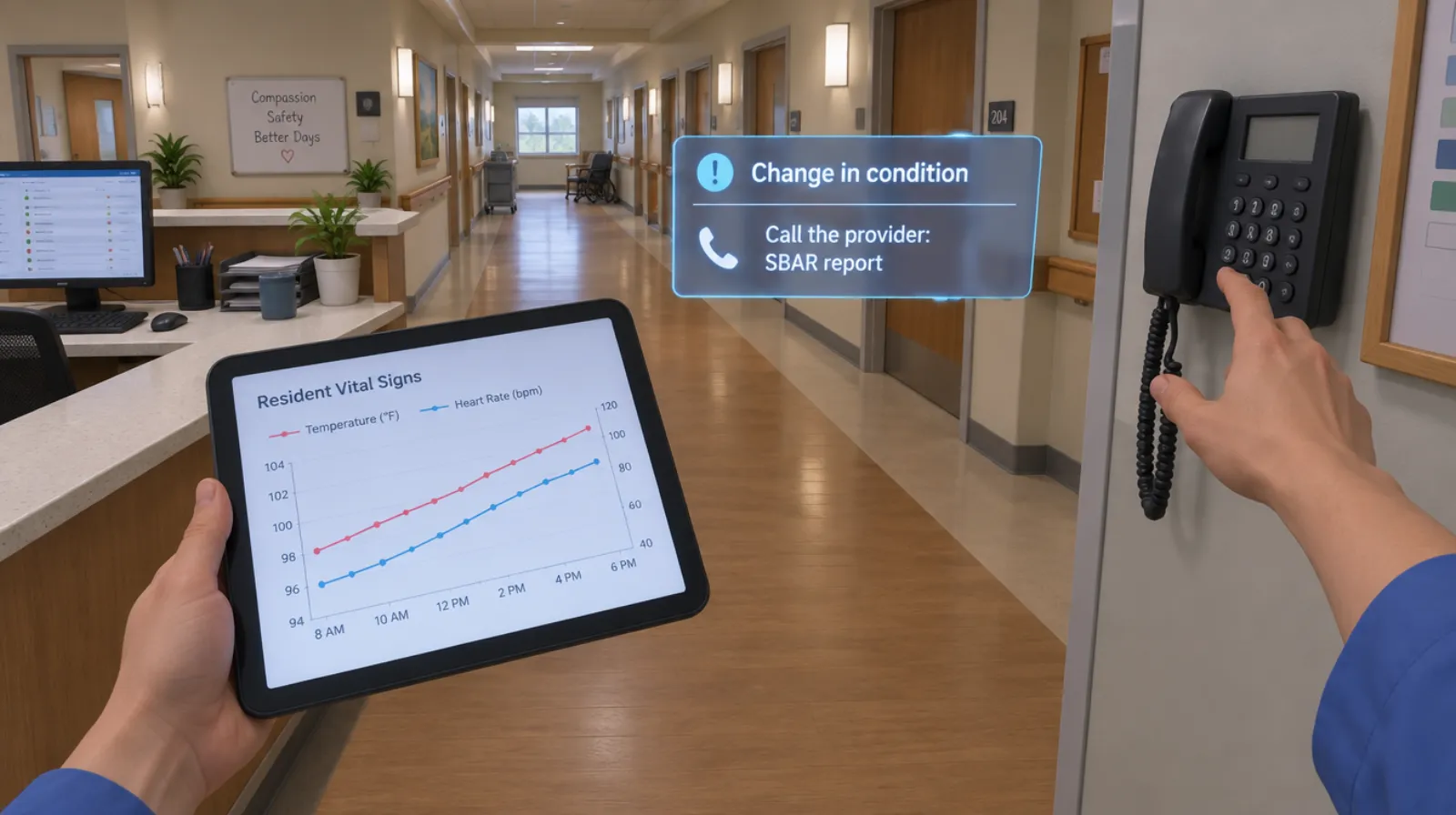
Learners compare a patient now with the same patient earlier, take vital signs, and decide whether something has changed. Then they call the nurse or provider with a clear SBAR report and a specific request.
- Every action, decision, and word recorded and analyzed
- Runs on Meta Quest headsets, managed from the Bubbler Hub
- Adapted to your procedures before rollout
- Built on our Notice the Change nursing Sim Lab, which teaches vital signs and SBAR handoffs.
Signs you need this
Signs your training needs more practice
Changes are caught late
A resident who was quieter at lunch is found much worse at dinner.
Staff wait for complete numbers
Aides hold off on reporting until every vital sign is taken, even when something is clearly wrong.
Reports are hard to act on
Calls to the provider are vague and end without a clear plan.
Equipment problems become bad readings
A loose cuff or cold fingers produce a number nobody questions.
Handoffs lose information
What the day shift noticed doesn’t reach the night shift.
What the module includes
5 chapters, in the order the work happens.
Learners can run the whole module or repeat a single chapter until they have it.
- 01
Prepare the person and the equipment
Hand hygiene, identify the person, explain what you are doing, and set up the tools.
- 02
Take and check vital signs
Blood pressure, pulse, oxygen saturation, temperature, and breathing, and spot a reading you shouldn’t trust.
- 03
Compare with earlier
Put this morning and this afternoon side by side and decide what changed.
- 04
Build the SBAR report
Situation, background, assessment, and a specific request, in the person’s own words where possible.
- 05
Make the call
Escalate even when the set is incomplete, and confirm what happens next.
What gets recorded
Every attempt, analyzed step by step.
- Preparation
- Hand hygiene, identification, and equipment setup.
- Readings
- Which measurements were taken, and whether unreliable readings were caught.
- Recognition
- Whether the learner noticed the change, and how long it took.
- SBAR
- Whether the report included each part and ended with a clear request.
Built around your work
Your procedure, not a generic one.
- Your escalation chain and on-call process
- Your SBAR or report template
- The equipment on your units
- Conditions your staff see most, such as infection or dehydration
Your subject-matter experts review the module before anyone trains on it.
- 01
Live view
Watch what the learner sees in the headset from a laptop or tablet, with the current task, step, and progress. The video stream isn’t stored; the session record is.
- 02
Session record
Every step taken or missed, in order and timed, plus the decisions the learner made and what they said.
- 03
Learner history
Every attempt for each person, so you can see what improved and what still needs another run.
- 04
Program dashboard
Completion across the group, the steps most people miss, and who needs another attempt or a conversation.
- 05
Reports and exports
Dated completion reports for each person, as PDF or data files, for training files, audits, and accreditation.
Not just another course
What changes when practice moves into a headset.
| Classroom or video | This module | |
|---|---|---|
| How people learn | Slides, video, or a demonstration | Doing each step themselves |
| Mistakes | Found later, on the job | Shown the moment they happen |
| Consistency | Depends on the trainer | Same scenario for everyone |
| Repetition | Limited by time, materials, and equipment | As many attempts as each person needs |
| Records | Sign-in sheet | Each step, decision, and attempt, by person |
Related modules
Often run together.
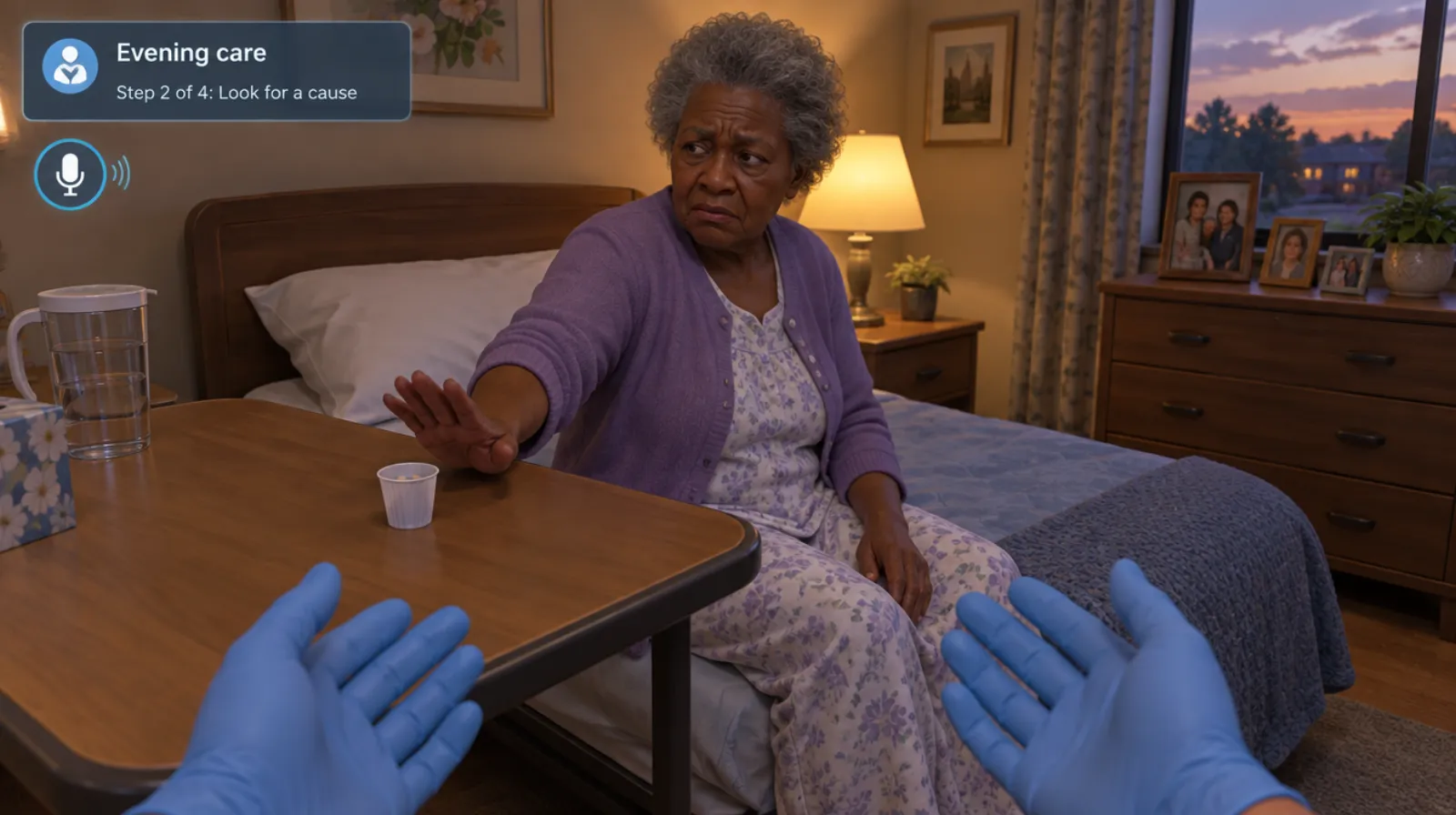
Dementia care
Agitation, care refusal, and late-day confusion in residents with dementia.
Read more →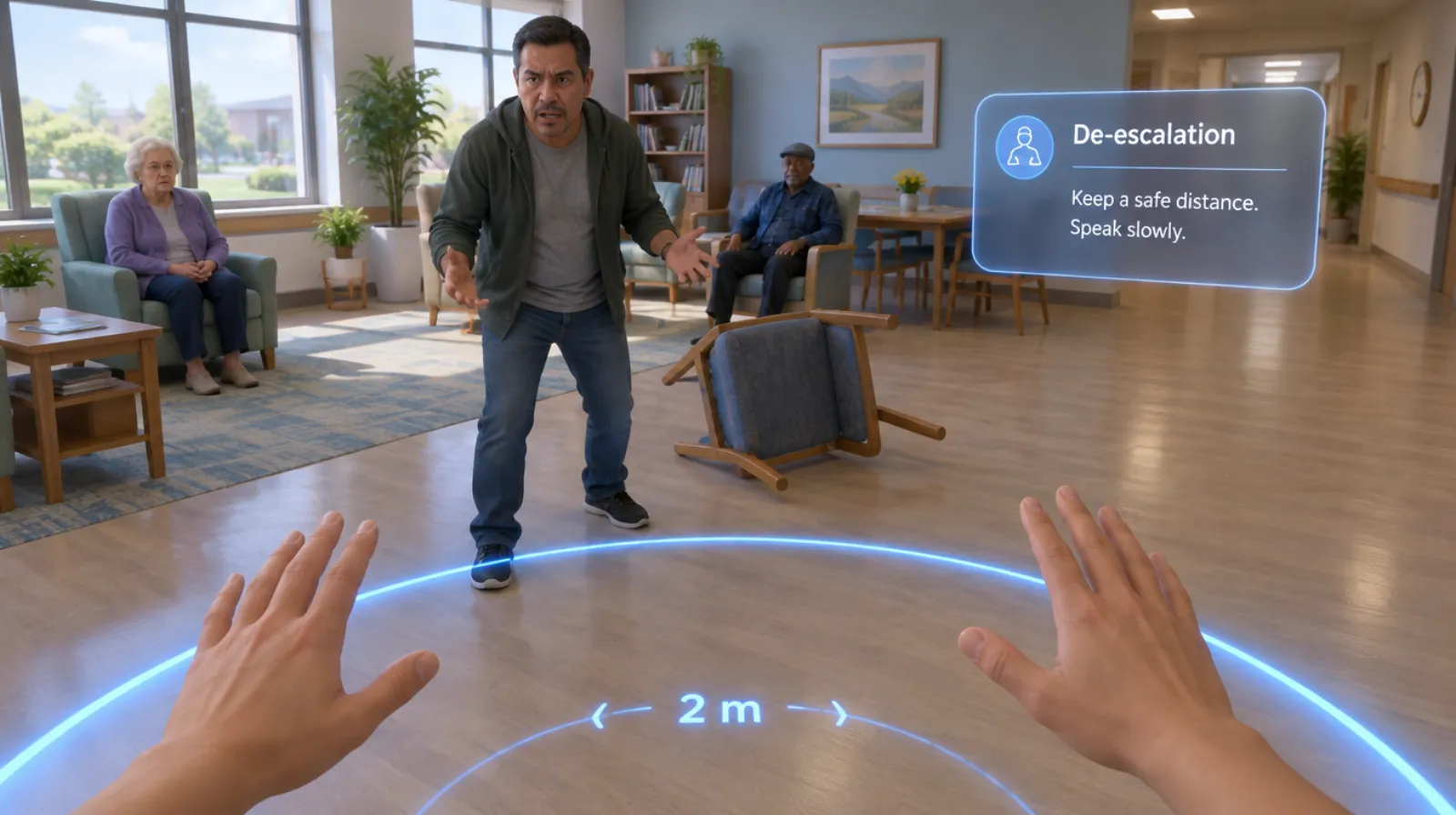
Behavioral health de-escalation
Keeping yourself and others safe when someone is in crisis.
Read more →Exit-seeking and missing residents
5 chapters
Exit-seeking and missing residents
Responding to a resident trying to leave, and to a resident who is missing.
Read more →Questions
About this module.
No. It teaches staff to notice a change, report it clearly, and ask for help. Diagnosis and treatment stay with nurses and providers.
See change in condition and sbar in a headset.
Book a demo and we’ll walk you through the module, show you what the records look like, and talk about adapting it to your team.