Skip to content
Bubbler Reality Labs

IndustriesHealthcare

Healthcare and nursing

Practice the hard moments of care before they happen at the bedside.

VR scenarios for dementia care, behavioral health, and everyday nursing work. Staff and students repeat the situations that are hard to teach in a classroom, and you get a dated record of who trained, what they did, and where they need more practice.

For nursing facilities, hospitals, home care agencies, nursing schools, and CNA programs.

Footage from a Bubbler nursing simulation.

Training today

  • The hardest situations are the least predictable

    A resident who refuses care or becomes frightened at night can’t be scheduled for a training day. New staff often meet it for the first time on shift.

  • Classroom dementia training is mostly listening

    Slides and videos explain redirection and validation. They don’t give an aide a chance to try it, get it wrong, and try again.

  • Training is hard to prove

    Sign-in sheets show who was in the room. They don’t show who can calm a resident, recognize a change, or give the nurse a clear report.

With VR practice

  • Meet the hard moment in practice first

    Staff rehearse agitation, refusal, and late-day confusion before they face them alone on a night shift.

  • Try it, get it wrong, try again

    Each scenario responds to what the learner does and says, so redirection becomes a skill rather than a slide.

  • A record of what each person did

    Dated records show who completed which scenario, what they missed, and who needs another attempt.

This is for

  • Directors of nursing and staff development coordinators
  • Nursing facility administrators
  • Nurse educators in hospitals and home care
  • Nursing and CNA program instructors

More scenarios

Scenarios for every part of the care team.

Nursing facilities

CNAs, LPNs, RNs, activity and dietary staff

Dementia care, behavioral health, and care for residents with cognitive impairments, where what staff say matters as much as what they do.

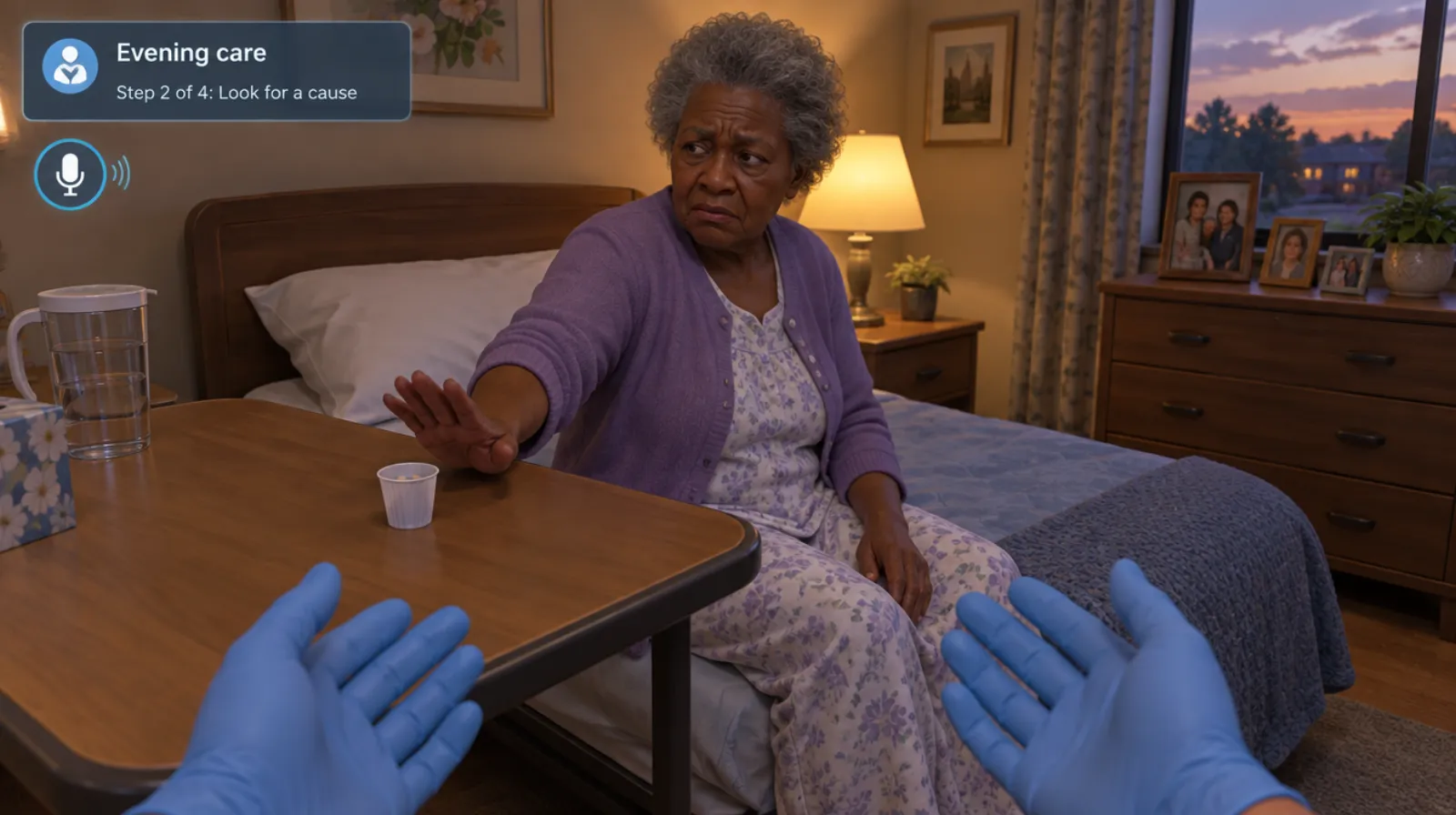
  • A resident with dementia becomes agitated during evening care
  • Late-day confusion and restlessness
  • A resident refuses a shower or medication
  • Exit-seeking and a resident who is missing from the unit
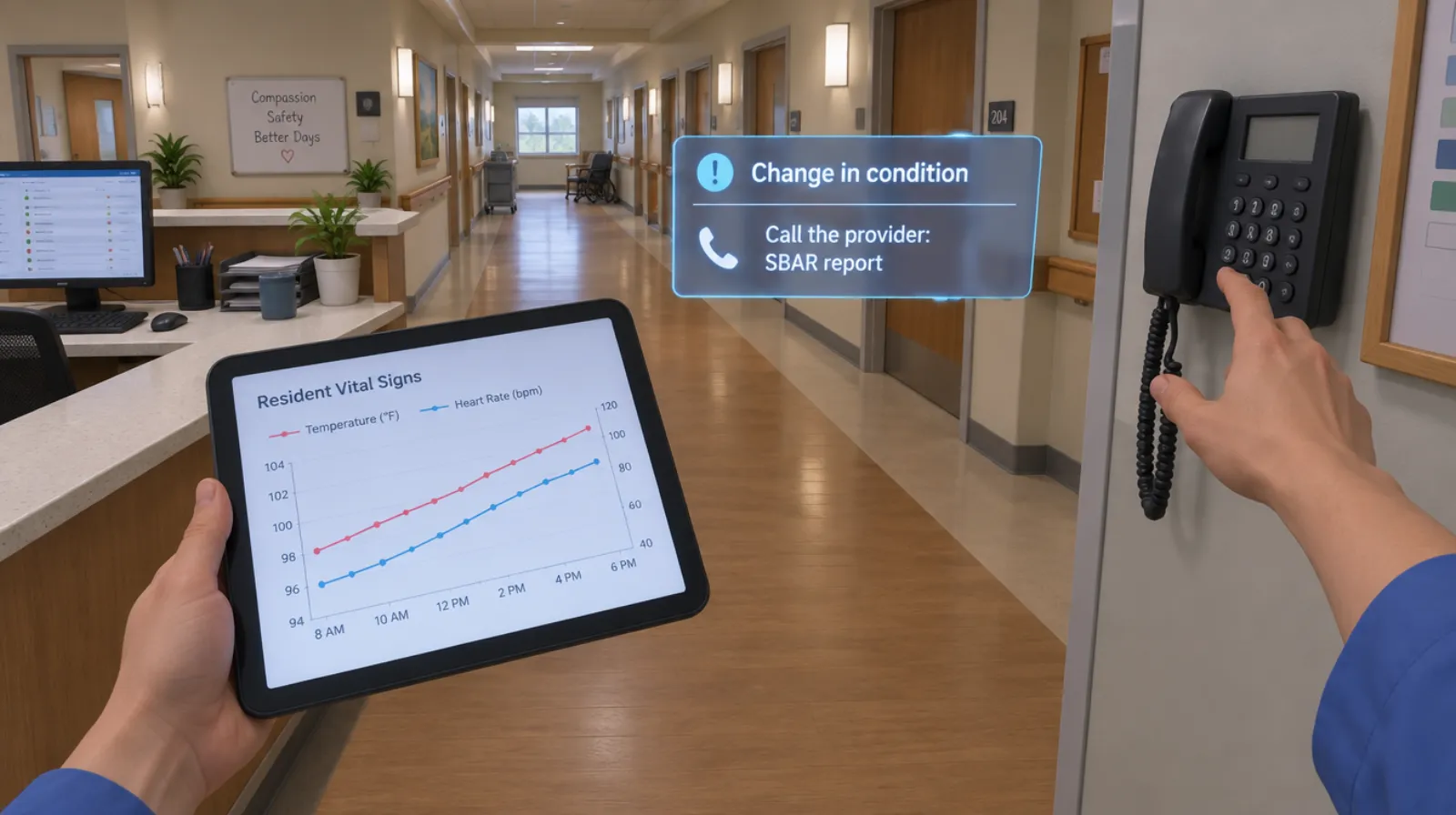
  • Noticing a sudden change that could be delirium or infection
  • Calling the provider with an SBAR report after a change in condition
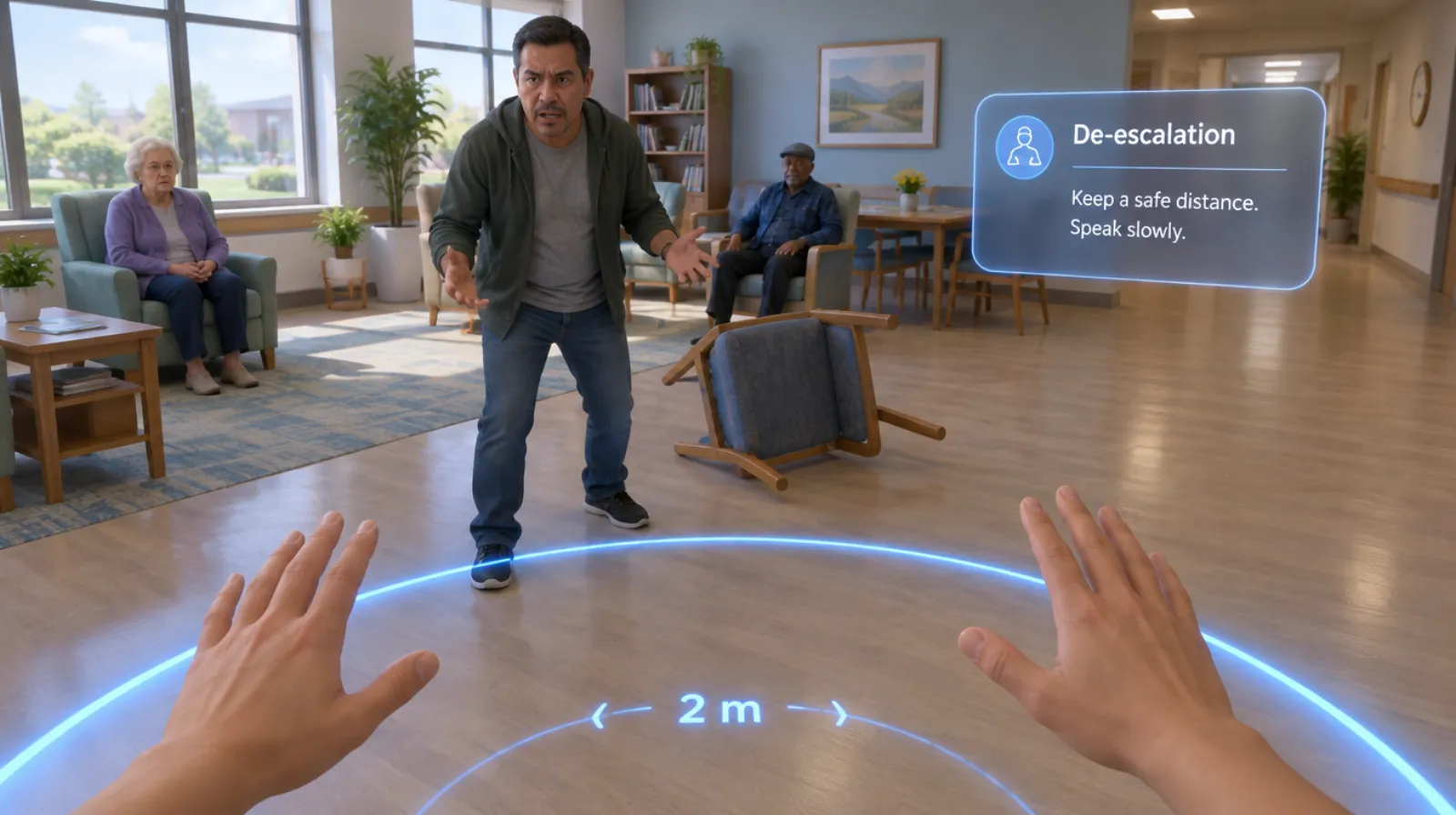
  • De-escalating a resident in behavioral health crisis
  • A family conversation about a parent’s decline

Hospitals and clinics

Nurses, patient care techs, float pool, new graduates

Repeatable practice for recognizing deterioration, escalating early, and handing off clearly.

  • Taking vital signs and reporting a change
  • Recognizing a patient who is getting worse and calling for help
  • Responding to a fall and checking the patient afterward
  • Hand hygiene and putting on and taking off PPE in order
  • Shift-change handoff
  • Medication pass safety checks

Nursing schools and CNA programs

Colleges, CTE programs, and workforce training providers

Students practice in the classroom before clinical placement, so supervised clinical time goes further.

  • Pre-clinical rehearsal of assessments and procedures
  • Assigned scenarios students repeat until they are ready
  • Instructor review of each student’s attempts
  • Health career exploration for high school pathways

A scenario, step by step

A resident refuses her evening medication

It is 6:40 p.m. Mrs. D., who has moderate dementia, pushes the cup away and says she wants to go home.

  1. Approach

    Introduce yourself, get to eye level, and notice the time of day and the noise in the room.

  2. Look for a cause

    Check for pain, fear, hunger, or a need for the bathroom before trying again.

  3. Redirect without force

    Acknowledge what she said, offer a choice, or step away and come back.

  4. Report it

    Tell the charge nurse what happened and what you tried, in an SBAR format.

Afterward: The supervisor sees which steps were taken, what the learner said to Mrs. D., and whether the refusal was reported.

Analytics and reports

From one person in a headset to your whole program.

Every action, decision, and word in a module is captured, analyzed against your standard, and reported in the Bubbler Hub. Supervisors see it at five levels.

  1. 01

    Live view

    Watch what the learner sees in the headset from a laptop or tablet, with the current task, step, and progress. The video stream isn’t stored; the session record is.

  2. 02

    Session record

    Every step taken or missed, in order and timed, plus the decisions the learner made and what they said.

  3. 03

    Learner history

    Every attempt for each person, so you can see what improved and what still needs another run.

  4. 04

    Program dashboard

    Completion across the group, the steps most people miss, and who needs another attempt or a conversation.

  5. 05

    Reports and exports

    Dated completion reports for each person, as PDF or data files, for training files, audits, and accreditation.

What is recorded in a care scenario.

Care steps
Hand hygiene, identifying the resident, asking before touching, and the steps of the procedure, in order.
What was said
Whether the learner validated, redirected, or argued, and how the resident responded.
Recognition
Whether the learner noticed the change in the resident, and how long it took.
Escalation
Who was told, when, and whether the report included the situation, background, assessment, and request.
Completion
Dated completion for each person and each scenario, ready for training files, surveys, and audits.

Dementia care, fall 2026

Sample facility, fictional data

Sample
Staff enrolled
24
CNAs, LPNs, RNs
Completed all scenarios
17
7 still practicing
Average attempts
2.3
per scenario
Completion reports
17
ready to export

Most-missed steps, share of the group

  • Checked for pain before redirecting41%
  • Reported the refusal to the charge nurse29%
  • Offered a choice instead of repeating the request22%
  • Spoke at eye level12%
PersonScenarioAttemptsNext step
A. Reyes, CNACompleteEvening care refusal3None
J. Okafor, CNAPracticingExit-seeking resident2Report missing resident sooner
M. Chen, LPNCompleteChange in condition1None
T. Silva, CNANot startedLate-day confusion0Assign this week
Sample program view. Names and numbers are made up to show the layout.

Questions

Before you book a call.

VR practice does not replace required clinical hours, state certification, or a facility’s competency sign-off. It gives staff and students more repetitions before the real situation.

A record of every attempt: each step taken or missed, the decisions made, what the learner said to the resident, and how long it took. Across the group, you see which steps most people miss and who needs another attempt.

See what your staff actually do in the hard moments.

Book a call. We’ll show you a care scenario, the record it produces for each person, and how a first rollout would work for your team.

VR trainingBook a call