Pharmaceutical and life sciencesDeviation recognition and reporting
VR training module
Notice it, stop, and report it the right way.
During a routine operation, something goes wrong: a reading out of range, a damaged seal, a missed signature. Trainees decide whether it is a deviation, stop when they should, and report it with the information quality needs.
- Every action, decision, and word recorded and analyzed
- Runs on Meta Quest headsets, managed from the Bubbler Hub
- Adapted to your procedures before rollout
Deviation recognition and reporting
- 01Routine operation
- 02Something isn’t right
- 03Stop and secure
- 04Report
- 05Document
Signs you need this
Signs your training needs more practice
Deviations are found late
Problems are discovered at batch record review rather than when they happened.
Staff fix things quietly
People correct a problem themselves instead of reporting it.
Reports lack detail
Investigations start without the facts quality needs.
Good documentation practice slips
Entries are late, crossed out incorrectly, or missing.
Fear of reporting
Staff worry about blame and hesitate to speak up.
What the module includes
5 chapters, in the order the work happens.
Learners can run the whole module or repeat a single chapter until they have it.
- 01
Routine operation
Carry out a normal task while documenting as you go.
- 02
Something isn’t right
Notice the out-of-range reading, damaged component, or missing step.
- 03
Stop and secure
Stop the operation when required and protect the product.
- 04
Report
Tell the right person and describe what, when, where, and what you did.
- 05
Document
Make correct entries following good documentation practice.
What gets recorded
Every attempt, analyzed step by step.
- Recognition
- Whether the problem was noticed, and how quickly.
- Decision
- Whether the learner stopped when the procedure says to.
- Report
- What the report included compared with what quality needs.
- Documentation
- Errors in the simulated batch record.
Built around your work
Your procedure, not a generic one.
- Your deviation categories
- Your reporting path
- Your batch record format
- Realistic problems from past deviations
Your subject-matter experts review the module before anyone trains on it.
- 01
Live view
Watch what the learner sees in the headset from a laptop or tablet, with the current task, step, and progress. The video stream isn’t stored; the session record is.
- 02
Session record
Every step taken or missed, in order and timed, plus the decisions the learner made and what they said.
- 03
Learner history
Every attempt for each person, so you can see what improved and what still needs another run.
- 04
Program dashboard
Completion across the group, the steps most people miss, and who needs another attempt or a conversation.
- 05
Reports and exports
Dated completion reports for each person, as PDF or data files, for training files, audits, and accreditation.
Not just another course
What changes when practice moves into a headset.
| Classroom or video | This module | |
|---|---|---|
| How people learn | Slides, video, or a demonstration | Doing each step themselves |
| Mistakes | Found later, on the job | Shown the moment they happen |
| Consistency | Depends on the trainer | Same scenario for everyone |
| Repetition | Limited by time, materials, and equipment | As many attempts as each person needs |
| Records | Sign-in sheet | Each step, decision, and attempt, by person |
Related modules
Often run together.
Infection control and PPE
5 chapters
Infection control and PPE
Hand hygiene and putting on and taking off PPE in the right order.
Read more →Machine startup and changeover
5 chapters
Machine startup and changeover
Pre-start checks, startup, changeover, and shutdown sequences.
Read more →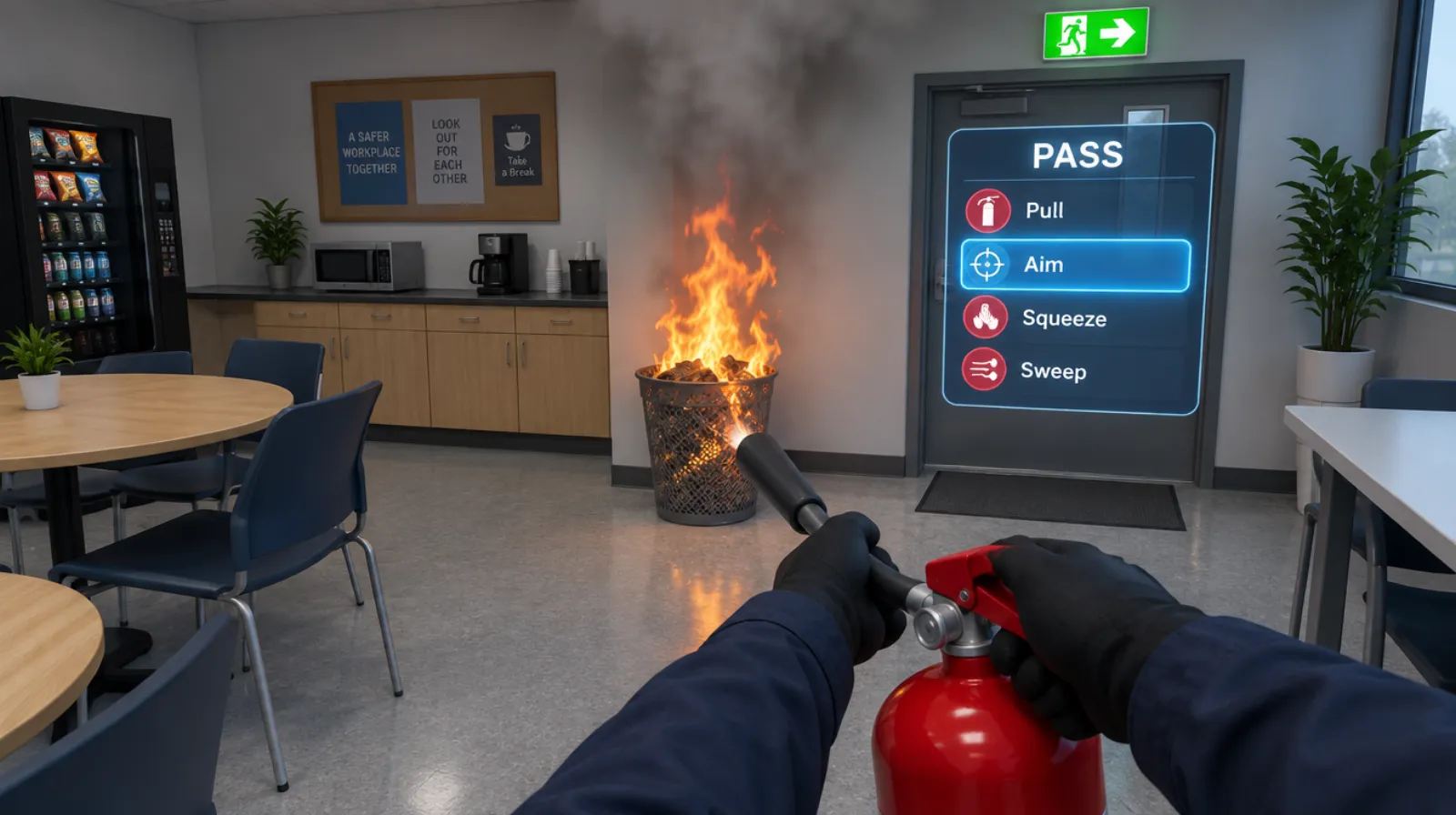
Fire safety
Raising the alarm, choosing the right extinguisher, and evacuating.
Read more →Questions
About this module.
Yes. We recreate the relevant pages so trainees practice on familiar forms.
See deviation recognition and reporting in a headset.
Book a demo and we’ll walk you through the module, show you what the records look like, and talk about adapting it to your team.